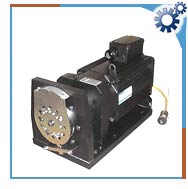
An actuator is a mechanism that puts something into automatic action.
It is a mechanism by which an agent acts upon an environment. The agent
can be either an artificial intelligence agent or any other autonomous
being. Some examples of actuators of these various agents are arms,
hands, fingers and legs in human and g.htmling mechanism and moving parts
in robot.
Actuators are the final elements in a control system. They receive a
low power command signal and energy input to amplify the command signal
as appropriate to produce the required output.
History
In mid sixties, automation and modern process control systems start to
influence industry. Especially in process technology, the central
controls of the operation processes become a dominating subject. In
large industrial units often hundreds of valves are operated at the same
time. Valve and machine actuators were ideas that turned into a product.
Werner Reister and Rudolf Dinse start the development of the first range
of actuators. They believed that actuators should be robust and
reliable. Actuators were first used in water and sewage treatment
plants. SA 8 - SA 18 is the first marketable series of actuators with
the trademark AUMA. Despite small quantities in the beginning, the basis
for further development was created.
Types
There are various types of actuators:
- Electromagnetic Actuators - Exploit the mutual
attraction of soft ferrous materials in a magnetic field. The
device has one coil that provides the field energy and the
energy to be transformed. The attractive force is unidirectional
so a return device of some type is needed, often a spring.
Relays or solenoids based on this principle are widely used in
cars to switch a range of electrical equipment with a current
demand of more than about 10amps-fans, headlights, horns, and
wipers.
- Electrodynamic Actuators - Based on the force
generated when a current carrying conductor is held in a
magnetic field. DC motors are frequently used as part of an
actuator system.
- Linear Actuator - Provide a linear motion via a motor
driven ball screw or ACME screw assembly. The linear actuator's
load is attached to the end of the screw, or rod, and is
unsupported. The screw can be direct, belt, or gear driven.
- Pneumatic Actuators - Uses a pneumatic cylinder. They
are used for opening and closing of grippers. Some of the
actuators achieve limited rotary motion by using the linear
actuator to turn a shaft with a rack and pinion gearing system,
or with a chain.
- Hydraulic Actuator - Uses a hydraulic cylinder.
Hydraulic fluid cannot be used for energy storage, so another
power source must be used to create pressure in the oil. The
flow of oil into the cylinder is controlled by a distributor-a
set of tubes that rotate with the shaft. Rotary hydraulic
servo-drives are often used in robotics.
- Electric Actuators - Two types of electric motors are
in use - stepper motors and direct motors. Stepper motors are
driven by a train of electrical pulses. Direct motors are most
common in industrial robots.
- Piezoelectric Actuators - Piezoelectric is a property
of a crystal to expand when electric voltage is applied to it
and return to normal when the electric voltage is cut. These
actuators exhibit characteristics like extreme rapid response,
ultra-minute movements and amazing power. They are widely used
in the precision opening and closing of valves in semiconductor
manufacturing equipment.
|
Applications
Geared actuator applications range from simple low power switches to
high power hydraulic devices operating flaps and control surfaces on
aircraft, valves, car steering, etc.
Actuators are used for the automatic control of a variety of valves, as
well as other applications requiring high torque precision rotation in a
small footprint. Typical applications of actuators are laboratory
automation, PC controlled valve actuation, small valve control in
production environment, and OEM automated sampling and measuring
devices. They are also used in industrial applications and commercial
applications.


